
Skip To Content

Our Pipeline

A couple kayaking down a river

Our lead clinical candidate is JBI-802, a first-in-class small-molecule being developed to treat blood disorders that can lead to high unmet-need cancers. Clinical trials are currently underway in multiple indications, both company-sponsored and investigator-sponsored.

Target
Dual LSD1 &
HDAC6 CoREST
Inhibitor
Molecule
JBI-802
Molecule
Indications
Essential
Thrombocythemia
(ET)/MPNs
PhasePre-Clinical (IND)Phase 1/2
Phase 1/2
Status
  • Dose escalation ongoing
  • Potential registrational study in 2027
Target
Dual LSD1 &
HDAC6 CoREST
Inhibitor
Molecule
JBI-802
Molecule
Indications
mSTK11 
IO resistant NSCLC
PhasePre-Clinical (IND)Phase 1/2
Phase 1/2
Status
Phase 2 IST ongoing
Target
Dual LSD1 &
HDAC6 CoREST
Inhibitor
Molecule
JBI-802
Molecule
Indications
Post MPN-AML
PhasePre-Clinical (IND)Phase 1/2
Pre-Clinical (IND)
Status
Planned Phase 1b/ 2 IST

About JBI-802

JBI‑802 is an investigational first‑in‑class dual LSD1/HDAC6 small molecule inhibitor that builds on validated LSD1 CoREST biology, aiming to enable a broad and more complete biological response. By combining LSD1 inhibition with HDAC6, thereby extending beyond the CoREST complex into additional regulatory domains not addressed by LSD1 inhibition alone, JBI‑802 is designed to deliver efficient, titratable target engagement while minimizing prolonged systemic exposure.
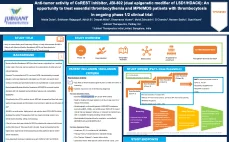
JBI-802 in Essential Thrombocythemia (ET)

Mechanistic Rationale for JBI-802 in ET

  • LSD1 and HDAC6 activity is elevated in people with essential thrombocythemia (ET), a rare, chronic blood condition that occurs when the bone marrow produces too many platelets.

  • LSD1 functions as a critical downstream effector of the driver mutations - CALR, MPL and JAK2, the primary causes of ET.

  • HDAC6 is highly expressed in platelets and regulates the production and function of platelets, positioning it as a key target to control thrombocytosis in ET.

  • We believe that dual inhibition of LSD1 + HDAC6 may drive deeper, durable transcriptional reprogramming in ET versus singly targeted agents.

Early JBI-802 Clinical Results

  • In clinical studies to date, JBI‑802 has demonstrated rapid platelet normalization, consistent leukocytosis control, and titratable, reversible cytoreduction.

  • In addition, in an earlier Phase 1 study conducted in advanced solid tumor patients, JBI-802 showed a dose-proportional increase in exposure across cohorts and a strong correlation between exposure and reduction in platelets. There were no reports of dysgeusia or anemia, typical adverse events seen with inhibitors solely targeting LSD1.

Ongoing Phase 1/2 Clinical Trial in ET

  • We are currently conducting a Phase 1/2 open-label, multicenter trial of oral JBI-802 as second-line therapy in people with essential thrombocythemia (ET) (ACTRN12624000478516 ; NCT07612280).

  • The trial is evaluating the safety and tolerability of once-daily oral JBI-802 in ET patients who have failed at least one standard therapy or who are intolerant to standard of care. Part 1 is a dose-escalation phase; Part 2 is a dose-expansion phase that will evaluate reduction of platelets, durability of platelet and white blood cell (WBC) count reduction, and reduction in variant allele frequency (VAF).

  • The Phase 1/2 trial is currently being conducted in Australia; we anticipate filing a U.S. Investigational New Drug Application (IND) shortly to begin study in the U.S. and will request Orphan Drug Designation status at that time.

Access MPN-t, MDS/MPN-t Phase1/ 2  Study Design (ASCO 2025)

Read More about this topic

JBI-802 in Other Potential Indications

Myelofibrosis (MF):

  • Clinical proof of concept for the CoREST pathway has been established with investigational LSD1 inhibitors in myelofibrosis, supporting the therapeutic relevance of this biology.

  • HDAC6 expression has been associated with disease features including splenomegaly and fibrosis, and preclinical data suggest that HDAC6 inhibition may play a role in modulating fibrotic biology.

  • Goals of a dual LSD1 + HDAC6 inhibitor: potentially augment LSD1 response to provide deeper, more durable control than standard of care.

Polycythemia Vera (PV):

  • Clinical proof of concept has been established with an investigational LSD1 inhibitor here as well, with results showing: hematocrit reduction in 85% of participants, platelet reduction in 90% of participants, white blood cell (WBC) count reduction in 75% of participants, and spleen reduction in 40% of participants.

  • Clinical proof of concept is also available from an investigational non-specific HDAC inhibitor, showing a >80% response rate with long-term follow-up.

  • Goals of a dual LSD1 + HDAC6 inhibitor: improve hematocrit, platelet, and WBC control; reduce JAK2 signaling; provide durable disease control with greater reduction in molecular burden than standard of care.

See all of Jubilant Therapeutics Publications

Our Publications